After such a long time waiting for it, according to my web page statistics, I finally get into realizing this part about all methods allowing the observation of the third dimension. As it is, nearly every time, a question of tool, it seems convenient to me to sort by that criterion.
Standard eyes | Trained eyes | Viewer | Passive glasses
Use of a standard pair of eyes.
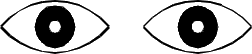
This is to say the use of our stereoscopic viewing base equipment: Our two eyes and our brain to traduce the viewing of two images in volume. I stop for a kind of small philosophy asset. Mother Nature gave to all animals at least a pair of eyes with two king of disposition:
- Side by side with parallel axis. This is the way human eyes are set and more generally predators. This is to say living beings able to locate precisely in space a moving object and able to catch it. In the Nature, that is evidently eating that same object, witch make this character a must for predators. Human beings found a lot more applications to that ability such as ball games...
-The more unlucky, but also more tasty, animals, such as herbivores have generally two eyes offering a vision more panoramic than stereoscopic. For them, it’s better to be vigilant than to see the third dimension.
Usual space viewing
Holograms
Lenticular lens
Standard eyes | Trained eyes | Viewer | Passive glasses
Use of a trained pair of eyes.
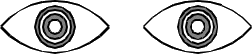
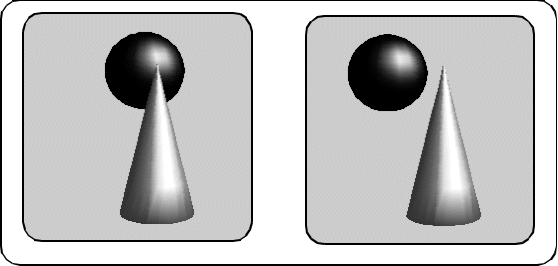
Parallel viewing
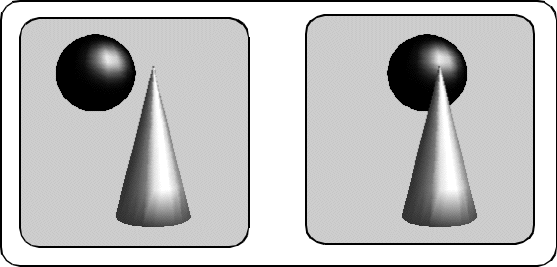
Crossed viewing
L-R-L or R-L-R
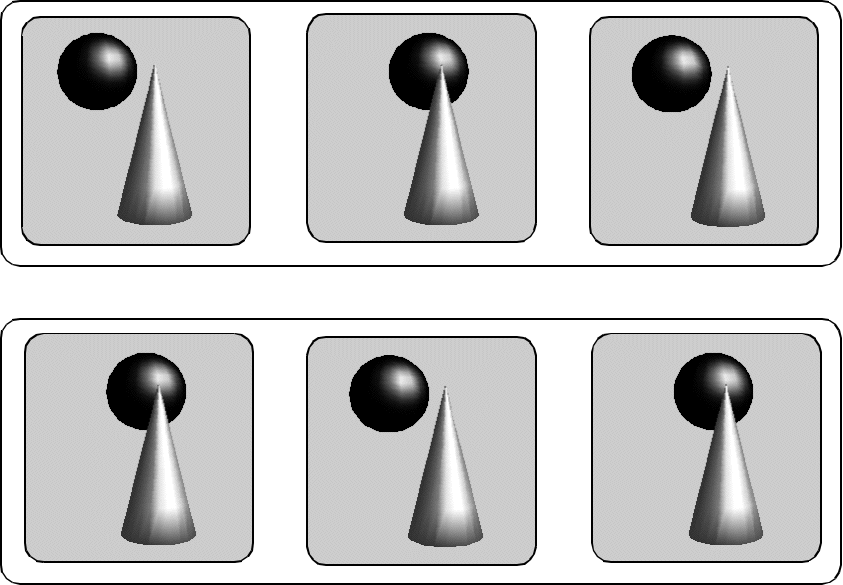
Between the parallel and the crossed viewing, there are perpetual fights among pros and cons of either one or other method. Some just considers the “crossed” one and others only the parallel. Others, like me, are not able to cross the view, so unable to cross-view. Some others, too familiar with cross-viewing can’t anymore see parallel pairs. In order to all those people to agree, there is a lot of devices to facilitate the viewing of both kind of pairs. Those apparatus, called viewer, will be seen in the next chapter. But before switching to those helpful apparatuses, one more method is remaining for top-trained eyes.
Stereograms et autostereograms
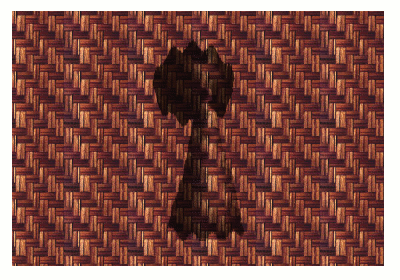

As with stereo pairs, there are crossed-viewing and parallel-viewing versions.
This method does not allow to record the three dimensions but to build it and stuck it to a pattern. It is not possible to reproduce colour but the 3D effect can be very intense.
Standard eyes | Trained eyes | Viewer | Passive glasses
Use of a viewer.
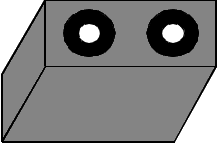
Mirror (Wheastone stereoscope)
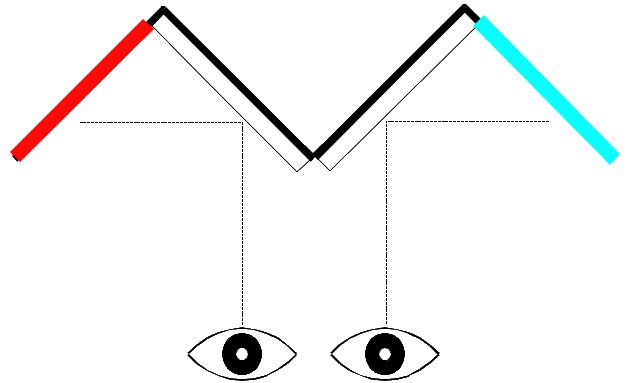
Bad thing: In the original version, the two images are left-right mirrored. A more modern design adding a second pair of mirrors put the image the correct way.
Lenses (Brewster Stereoscope)
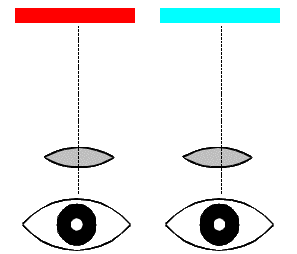
Defect: Apparatuses generally quite bulky witch can be used just by one person at a time.
Advantages: Good vision of 3D and ease of manufacturing. It provided a lot of mythical stereoscopes such as Vérascope, Bruguière and Lestrade Stereoscope, the ViewMaster and more recently 3D postcards (simple stereo-pair with two lenses in a folding cardboard box).
Prisms (Holmes Stereoscope)
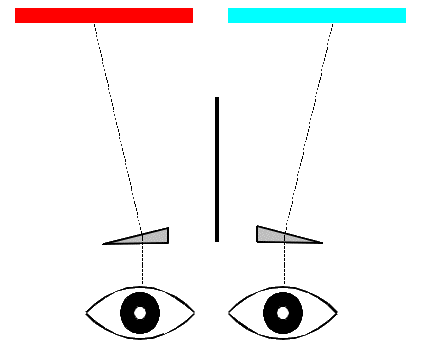
Two small screens visor (Head Mounted Displays)
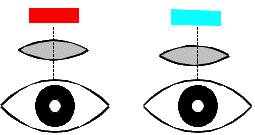
Advantage: It is possible to see moving pictures and also movies with that system.
Defect: the spectator’s head is set into a kind of box quite impressive.
This type of viewing the third dimension using viewers has the great defect to be individual. Of course, it could be considered that the kind of initiation, such as peace pipe, is an advantage: The viewer goes from hand to hand sharing slowly the three dimensions. But, when the group is more than half-dozen persons, the session is majority of waiting times. The remedy is to use projection-based methods.
Standard eyes | Trained eyes | Viewer | Passive glasses
Use of a pair of passive glasses.

Anaglyphs and company
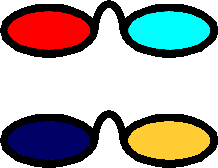
Defect: The use of blue or green opposed to the red forbids the correct viewing of colours, whereas choosing the cyan instead, leads to a quite correct reproduction of colours if neither of the two filters colours are present. There is a kind of “norm” consisting in putting the red filter in front of the left eye and the cyan filter in front of the right eye. Some smart people, are still patenting optimised process by changing the colours of the filters used. There is no special advantage and the defects are also the same. It can be noticed that the amber-blue combination sold in quantity as “Color Code” works quite well for tomatoes with blue sky as a background. Nevertheless, it causes great visual discomfort due for the great contrast between the two filters.
Anaglyphs are now developing its number of fans because it is easy to set and view on a computer screen or with video-projector. To shows that you may have a look at the very active Yahoo group “Anaglyphs” (11676 messages in 2005 with a great proportion of anaglyphs in the posts). If you want you can have a look at the group’s archives and see the artworks of the world greatest anaglyphs creators. Of course, you can sign-in for this Yahoo group and post your anaglyphs on it in order to take profit of advices of members to progress with the help of the very best specialists.
Polarised
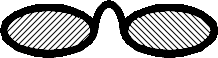
Advantages: The reproduction of colours is very realistic. The polarised glasses are, as anaglyph glasses, quite easy to buy and cheap. Thus, that method results, the favourite of stereoscopists for group presentation.
Use of an active separator.

Shutter glasses
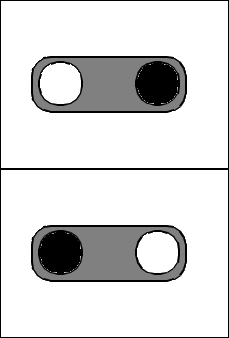
In order to permit to each eye to only see its corresponding image, the device (active glasses) hide alternatively one eye synchronically with the screen.
Advantages: Easy to set-up, even on a big screen,, if you have the hiding device.
Disadvantages: Price of the device included actives, so expensive, glasses for each spectator.
Passive glasses with Byatt modulator (Liquid Crystal Color Shutter)
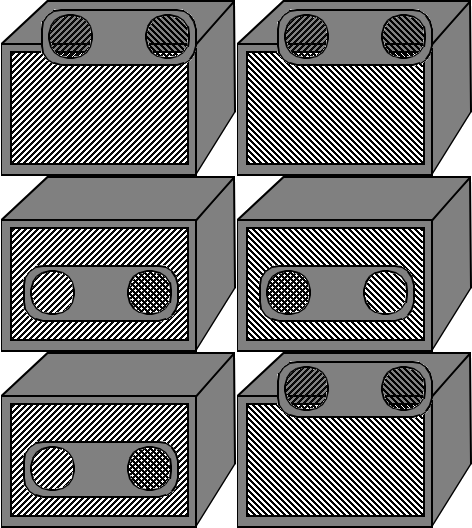
At that time, I was not a stereo-photo addict but I imagine that same screen in the cellars of my laboratory of that period ; poor fellow how it must be boring! Maybe it is just the memory that makes that system one of the best I ever test to view 3D? Of course I was looking at “MY” molecule. That image is reconstructed with RasMac 2.7.2.1 from the 1993 “.pbd” file resulting of the optimisation with the Tektronix system. the only thing remaining except what I remember.
Advantage to the previous system: Use passive, thus cheap glasses.